
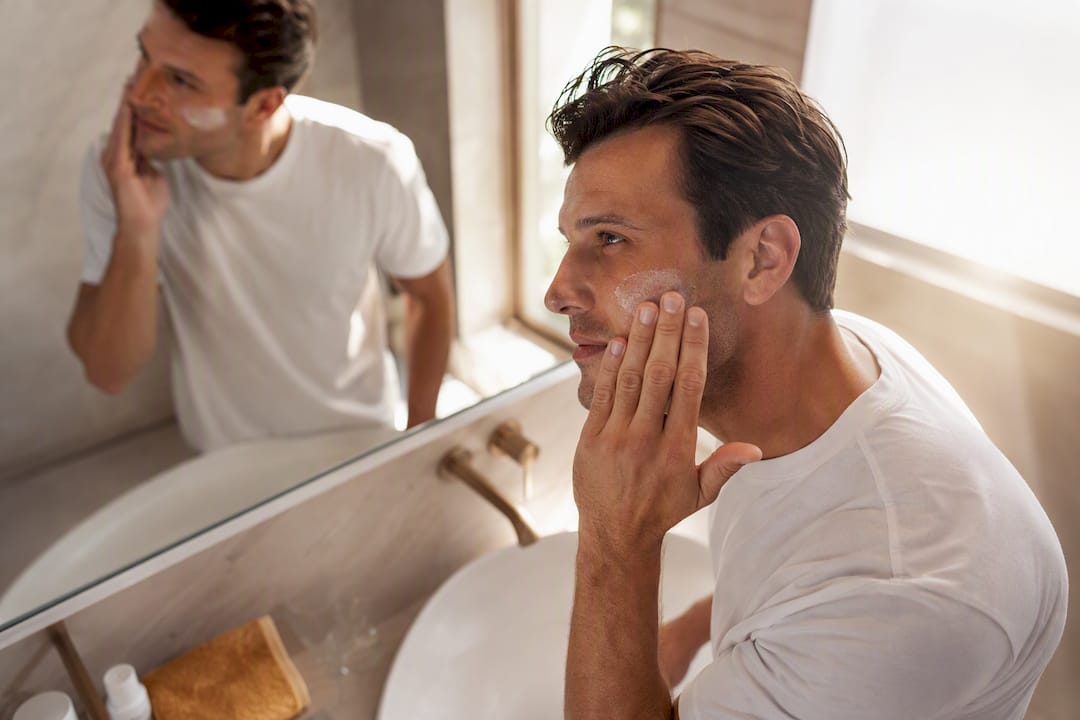
The most effective skincare routine for men is three steps in the morning, cleanse, moisturise, apply daily sunscreen with broad-spectrum SPF 30 or higher, and a slightly longer version at night, cleanse, treat, moisturise. Consistency is more important than complexity in skincare routines. Daily sunscreen is the single highest-impact habit you can build, and everything else, serums, retinol, exfoliation, is worth adding only once that foundation is solid. If a mole changes shape or acne won't budge, see a dermatologist rather than another product.
TL;DR:
- Using SPF 30+ daily and reapplying during extended outdoor exposure is the most impactful habit for long-term skin health and anti-aging.
- Men should keep their SPF moisturizer visible in the bathroom to ensure consistent morning use rather than leaving it in a drawer.
- Introducing retinol gradually, starting two nights a week, reduces irritation and improves skin texture over six to twelve weeks.
- A tailored routine based on skin type—oily, dry, sensitive, or combination—significantly reduces irritation and improves results.
- Consulting a dermatologist is recommended for persistent acne, changing moles, or skin problems that do not improve with over-the-counter products.
Table of Contents
- Building your morning skincare routine for men step by step
- What should a men's night skincare routine include?
- Choosing skincare products for your skin type
- Which active ingredients matter and when to use them
- How to shave without wrecking your skincare routine
- When to see a clinician or dermatologist about your skin
- How lifestyle habits affect men's skin health
- Adjusting your routine for winter and summer
- Common mistakes that sabotage a men's skincare routine
- How to layer products in the right order for best results
- Adjusting your routine as you age or your concerns change
- Sticking with a routine that actually works
- When home care needs a professional partner
- Sources
- FAQ
Building your morning skincare routine for men step by step
A morning skincare routine for men should be quick and simple enough to follow in challenging mornings. The order matters more than the number of products you own.
1. Cleanse with something gentle. Overnight, your face collects oil, sweat, and whatever was on the pillowcase. A gentle, low-foam cleanser removes that without stripping the skin barrier you'll need intact for the rest of the day. Skip anything that leaves your face feeling tight or squeaky. That tightness is damage, not cleanliness.
2. Add an antioxidant serum, if you want one. Vitamin C can be beneficial in the morning, as an antioxidant that may help protect skin alongside sunscreen from environmental stress. that accelerates visible ageing. Niacinamide is the other reasonable morning choice, particularly if oiliness or enlarged pores bother you. Neither is compulsory. A three-step routine without a serum still counts as a proper routine.
3. Moisturise, then protect with SPF 30 or higher. This is where most men either simplify smartly or overcomplicate needlessly. A moisturiser with built-in SPF 30+ covers hydration and protection in one product, which is ideal if mornings are rushed. If you prefer a dedicated sunscreen, apply moisturiser first, let it settle for a minute, then layer sunscreen on top. Either approach works. What doesn't work is skipping SPF because it's cloudy or you're mostly indoors: incidental daily exposure through windows and on short walks adds up over years, and dermatologists consistently rank daily sunscreen as the most important anti-ageing measure available. Reapplication matters more than people admit. If you're outdoors for extended periods, midday, a construction site, a long walk, reapply every two hours. For a desk-based day, one solid morning application is usually enough.
For men who shave in the morning, sequence it between cleansing and moisturising: cleanse, shave, then move straight to serum and SPF. This avoids applying active ingredients to skin that's about to be scraped with a blade, which reduces stinging and irritation.
If you have very limited time, a simplified routine of applying a moisturiser with SPF after rinsing your face works better than skipping care entirely. It's not the ideal version, but it beats doing nothing, and it beats the version where you buy six products and use none of them consistently.
Pro Tip: Keep your SPF moisturiser on your bathroom shelf, not in a drawer. The products you actually use are the ones you see every morning, not the ones stored out of sight "for when you have time."
What should a men's night skincare routine include?
The evening routine has more room for building skin quality because you're not racing sunlight or a morning meeting. But more room doesn't mean more steps by default.
1. Cleanse once, unless you've worn sunscreen or make-up all day, then cleanse twice. A single gentle cleanse removes the day's grime for most men most nights. Double cleansing, an oil-based cleanser followed by a water-based one, makes sense specifically when you've had heavy SPF or sweat-heavy exercise, since dermatologists recommend cleansing twice daily as standard practice, with extra attention for anyone who shaves or has clogged pores.
2. Introduce a targeted treatment, starting slowly. Retinol is a commonly recommended nighttime ingredient for promoting skin renewal and improving texture over time. The mistake almost every man makes is starting too strong, too fast. Begin with a low-strength retinol two nights a week, not nightly, and only increase frequency once your skin tolerates it without redness or flaking. CeraVe and dermatology guidance both recommend this gradual ramp-up specifically to reduce irritation. If retinol proves too aggressive for your skin, niacinamide or a lower-strength retinal alternative is a reasonable substitute.
3. Finish with moisturiser to lock in hydration and buffer the treatment. Applying moisturiser after retinol, rather than before, gives a stronger effect for men who tolerate actives well; applying it first creates a gentler "buffered" version for sensitive skin.
On exfoliating a few times weekly is generally advised for men who shave regularly or have clogged pores, but not daily, whether you use a chemical exfoliant (a BHA like salicylic acid) or a mild physical scrub. Time it for a night when you're not also starting retinol, and never exfoliate immediately before or after an aggressive shave. That combination is the single most common cause of the burning, red patches men mistake for a "reaction to a new product" when it's actually just too much mechanical stress on the skin in one 24-hour window.
Choosing skincare products for your skin type
Get the texture and ingredient priorities wrong for your skin type and even a well-sequenced routine will feel like it's fighting you. Get them right and half your irritation problems disappear before you touch an active ingredient.
Work out your type with a simple test: cleanse your face, wait an hour without applying anything, then check how it feels.
- Shiny across the forehead, nose, and chin within the hour: you're oily. Look for gel textures and salicylic acid to manage sebum and keep pores clear.
- Tight, flaky, or uncomfortable: you're dry. Prioritise hyaluronic acid for water retention and ceramides to rebuild the skin barrier.
- Oily in the T-zone but normal or dry on the cheeks: you're combination, the most common type among men. A lightweight gel-cream usually splits the difference.
- Reacts to fragrance, stings with new products, or flushes easily: you're sensitive. Fragrance-free is non-negotiable, and every new product goes on gradually.
Men's skin also runs thicker and oilier on average than women's skin, with larger pores and more sebum production, which is part of why heavier, richly emollient creams marketed broadly often feel wrong on male skin and lighter gel-creams tend to perform better even for men who lean dry.
Label terms are worth understanding rather than trusting blindly. "Non-comedogenic" means a product is formulated not to clog pores, useful if you're acne-prone, but it's not independently regulated, so it's a signal rather than a guarantee. "Fragrance-free" means no added scent, distinct from "unscented," which can still contain masking fragrance chemicals that irritate sensitive skin.
Pro Tip: Patch-test any new active on your inner forearm for two nights before putting it on your face. If nothing happens there, you've saved yourself a week of looking sunburnt for no reason.
Which active ingredients matter and when to use them
Five ingredients cover the vast majority of what men's skincare actually needs. Everything else is largely a variation on these.
- Vitamin C – a morning antioxidant that brightens tone and helps defend against environmental stress; pairs well with SPF but shouldn't be layered directly under strong acids.
- Retinol – a night-time collagen stimulator for fine lines, texture, and acne marks; start twice weekly and never apply straight after an aggressive shave or a strong exfoliation session.
- Niacinamide – the most flexible ingredient available, regulating oil production and supporting the skin barrier; it plays nicely with almost everything, morning or night.
- AHAs and BHAs – chemical exfoliants for texture and clogged pores; salicylic acid (a BHA) suits oily, acne-prone skin, while gentler AHAs suit drier types, used two to three times weekly at most.
- Hyaluronic acid and ceramides – hydration and barrier repair, safe to use daily alongside almost any other active.
The safest general rule for layering actives: vitamin C in the morning, retinol at night, niacinamide whenever it fits your routine, and exfoliants on their own nights, never stacked with retinol. This single rule prevents the majority of the redness and peeling men report when starting an active-ingredient routine for the first time. Clinic-grade formulations of these ingredients, the kind found in professional-strength skincare supplies, tend to deliver more consistent results than drugstore versions because concentration and stability are tighter controlled.
How to shave without wrecking your skincare routine
Shaving is skincare, whether you treat it that way or not. Poor technique undoes a good routine faster than any missed serum.
- Cleanse first, then let warm water run over your face for thirty seconds to soften the hair before you pick up a razor.
- Shave in the direction hair grows, not against it, and swap blades every five to seven shaves. A dull blade drags rather than cuts, which is the main cause of nicks and irritation.
- Use a proper shaving gel or cream rather than bar soap. It reduces friction and protects the skin underneath.
- Finish with an alcohol-free balm or gel, not a stinging aftershave splash, which dries out skin that's already had its barrier disturbed.
- For ingrown hairs or razor burn, a salicylic acid pad two to three times a week keeps pores clear, but hold off on strong retinol or fresh exfoliation for at least a day after an aggressive shave.
When to see a clinician or dermatologist about your skin
Home routines handle most day-to-day skin concerns, but some signs warrant a professional opinion rather than another product swap.
A mole that changes shape, colour, or size deserves a same-week appointment, not a wait-and-see approach. Persistent, painful acne that hasn't responded to consistent cleansing and salicylic acid over eight to twelve weeks usually needs prescription-strength treatment. Sudden rashes, unexplained lesions, or skin that reacts badly to products you've used for years are also worth a proper assessment rather than guesswork.
- Stubborn acne unresponsive to over-the-counter actives after two to three months.
- New or changing moles, or any lesion that bleeds, itches, or won't heal.
- Visible sun damage, deep lines, or uneven texture where you want a more targeted result than home retinol can deliver.
Clinic treatments become worth considering once home care plateaus. Skin boosters, professional facials, and prescription-strength retinoids go further than shop-bought actives, and proper aftercare guidance ensures your at-home routine supports rather than undermines any in-clinic work. For acne specifically, clinic-based treatment options can address cases that have outgrown a bathroom-cabinet approach.
How lifestyle habits affect men's skin health
Your routine can only do so much against what's happening below the surface. Sleep deprivation raises cortisol, which increases oil production and slows the skin's overnight repair processes, precisely the window when retinol and moisturiser are meant to be doing their quiet work. Men consistently getting under six hours a night often see more breakouts and duller tone regardless of how good their products are.
Diet plays a smaller but real role. Diets heavy in refined sugar and dairy are linked, in some men, to increased breakouts, though the effect varies person to person rather than applying universally. Hydration matters less dramatically than skincare marketing suggests, water alone won't fix dry skin, but chronic dehydration does make skin look flatter and less resilient.
Stress deserves particular attention because it's cumulative and easy to dismiss. Chronic stress elevates cortisol long-term, which can worsen inflammatory skin conditions like acne and eczema and slow wound healing, meaning that razor nicks or blemishes take longer to settle down. None of this means you need to overhaul your life to get good skin. It means a great routine performed on four hours' sleep and constant stress will underperform compared to a decent routine backed by reasonable sleep and lower stress. Skincare and lifestyle aren't separate categories; they're the same project.
Adjusting your routine for winter and summer
Skin needs shift with the seasons, and treating your routine as fixed year-round is one of the more common reasons men plateau on results. Winter air, both outdoors and from indoor heating, strips moisture faster, which is when ceramide-rich moisturisers earn their keep and lighter summer gels start feeling inadequate. If your skin is flaking or tight through the colder months, that's a signal to size up your moisturiser, not a signal to add more actives.
Retinol use often needs adjusting too. Cold air already compromises the skin barrier somewhat, so if you're seeing more redness or flaking in winter, dropping retinol back to once or twice a week temporarily is sensible rather than pushing through.
Summer brings the opposite problem: heavier creams can feel greasy and clog pores in heat and humidity, and sweat combined with heavy actives increases irritation risk. This is the season to lean into gel textures, lighter SPF formulations, and more frequent reapplication of sunscreen if you're outdoors for extended periods. The core three-step structure, cleanse, moisturise, SPF, doesn't change between seasons. The weight and frequency of what fills each step does.
Common mistakes that sabotage a men's skincare routine
Most men who "try skincare and give up" fail for the same handful of reasons, not because skincare doesn't work for them specifically.
Buying too many products at once is the most frequent error. Introducing five new items in one week makes it impossible to know which one caused the breakout or irritation that inevitably follows. Add one product every one to two weeks instead.
Skipping SPF because it's cloudy, or because "it's just a five-minute walk," undoes the anti-ageing benefit of everything else in the routine. Related to this: applying sunscreen as the very last step but forgetting to actually rub it in fully, leaving a visible white cast that puts men off using it consistently. A tinted or gel-based SPF fixes this without sacrificing protection.
Over-exfoliating is close behind. Scrubbing daily "to get properly clean" strips the skin barrier and causes exactly the redness and sensitivity the product was meant to prevent. Two to three times a week is the ceiling, not the floor.
Finally, giving up after one week because "nothing's changed." Retinol takes six to twelve weeks to show visible texture improvement. Niacinamide needs four to eight weeks for oil regulation to stabilise. Consistency, not intensity, is what separates men who see results from men who don't.
How to layer products in the right order for best results
Layering rules exist because product texture and molecule size determine what can absorb through what. Get the order wrong and you waste the more expensive products by trapping them under something they can't penetrate.
The general rule: thinnest to thickest, water-based before oil-based. That means cleanser first, then any water-based serum (vitamin C, niacinamide), then treatment actives (retinol, exfoliants), then moisturiser, then SPF as the final morning step. Never apply a heavy moisturiser before a serum. It creates a barrier the active ingredient simply can't cross, which means you paid for a serum that's doing nothing.
Wait roughly sixty seconds between a serum and the next step to let it absorb properly, rather than immediately layering moisturiser on top while the serum is still sitting wet on the surface. With retinol specifically, applying it to slightly damp, not soaking wet, skin can increase irritation because water helps the ingredient penetrate faster than a dry face would allow. If you're new to retinol, apply it to fully dry skin.
SPF always goes last in the morning, full stop, since it needs to sit on the surface to form its protective film rather than being buried under moisturiser or serum.
Adjusting your routine as you age or your concerns change
Skin priorities shift with age, and a routine built for a 25 year old's oily T-zone won't necessarily serve a 45 year old dealing with fine lines and slower cell turnover. In your twenties and early thirties, acne and oil control tend to dominate, making salicylic acid and lightweight gel moisturisers the priorities. Retinol is worth introducing here too, not just for anti-ageing later but because it helps with acne marks and texture in the present.
From the mid-thirties onward, collagen production naturally slows, and this is when retinol frequency often needs increasing rather than decreasing, alongside adding a proper eye cream if fine lines around the eyes become noticeable. Vitamin C's brightening effect becomes more valuable here too, as tone tends to even out less on its own with age.
Razor bumps and ingrown hairs are a concern that spans every age group rather than fading with time, particularly for men with coarser or curlier facial hair, and the salicylic acid pad routine covered earlier applies regardless of how old you are. The one universal that doesn't change with age is SPF: daily broad-spectrum protection matters as much at 22 as it does at 62, since cumulative sun damage is the largest driver of the fine lines, dark spots, and texture loss that anti-ageing routines spend so much effort trying to reverse.
Sticking with a routine that actually works
The routines that work aren't the most advanced ones. They're the ones a man will actually repeat on a Tuesday morning when he's running late and hasn't slept properly. Start with SPF and one treatment product, retinol or salicylic acid depending on your concern, and give that combination two to three months before judging it. Everything else is refinement, not foundation. If there's one habit worth defending on your worst days, it's the sunscreen.
— Ms Sandra Petraskaite
When home care needs a professional partner
There's a ceiling to what cleanser, moisturiser, and SPF can do on their own, particularly for stubborn pigmentation, deeper lines, or acne that's outgrown over-the-counter actives. That's where a clinic assessment earns its place, not as a replacement for your daily routine but as the layer above it. Nexgen Clinic in Cambridge uses AI-driven skin analysis to build a treatment plan around your actual skin, rather than a generic protocol, and its signature programmes, including NexGen Age Reset™ and Facial Balance™, are designed to work alongside the kind of routine covered in this article, not against it.
A consultation typically starts with that skin analysis, followed by a plan tailored to whether your priority is acne, early ageing signs, or overall skin quality, and clinic aftercare guidance ensures your home routine supports whatever treatment you've had rather than undoing it. If you're dealing with a concern your bathroom cabinet hasn't solved in a few months, book a consultation through the Nexgen Clinic website to find out what a tailored plan would involve.
This article is general information, not a substitute for advice from a qualified doctor. Consult a qualified healthcare professional about your own circumstances before acting on anything here.
Sources
- Vogue — What Is the Ideal Skincare Routine for Men?
- Patient
- CeraVe — A men’s facial skincare routine for all skin types
FAQ
What is the best skincare routine for men?
The best routine for most men is cleanse, moisturise, and SPF 30+ every morning, with cleanse, a targeted treatment like retinol, and moisturise at night. It's the baseline dermatologists recommend before adding anything else.
What is the 4-2-4 rule in skincare?
There's no single, widely recognised dermatological standard for cleansing or product counts. Some skincare guides use numbered shorthand, but definitions vary enough that it's worth treating any version you see with caution rather than following it as an established rule.
What are the steps for a skincare routine for men?
Morning: cleanse, optional antioxidant serum, moisturiser with SPF 30+. Evening: cleanse, a targeted treatment such as retinol or a BHA when needed, then moisturiser. Exfoliation, when required, happens two to three times a week rather than daily.
Should men have a skincare routine?
Yes. Male skin tends to be thicker and oilier with larger pores than female skin on average, which affects product choice, but the case for a routine, protecting against sun damage and maintaining skin barrier health, applies equally regardless of gender.
How long does it take to see results from a new skincare routine?
Niacinamide and consistent cleansing typically show results within four to eight weeks. Retinol usually needs six to twelve weeks of consistent use before visible texture or fine-line improvement appears.
When should I see a dermatologist instead of adjusting my routine?
See a professional if acne persists past two to three months of consistent care, if a mole changes shape or colour, or if you notice unexplained lesions. Nexgen Clinic offers assessments for concerns that have outgrown an over-the-counter routine.
Recommended
- Post treatment skincare: clinic-backed aftercare guide
- Dehydrated skin treatment: the fastest way to restore hydratio
- Treatment for Dull Skin
Ready to explore your options?
Speak with a NexGen clinician for a personalised consultation. We’ll listen, assess, and recommend the safest and most effective route — always led by evidence, always tailored to you.
Book a consultation or get in touch with our Cambridge team.