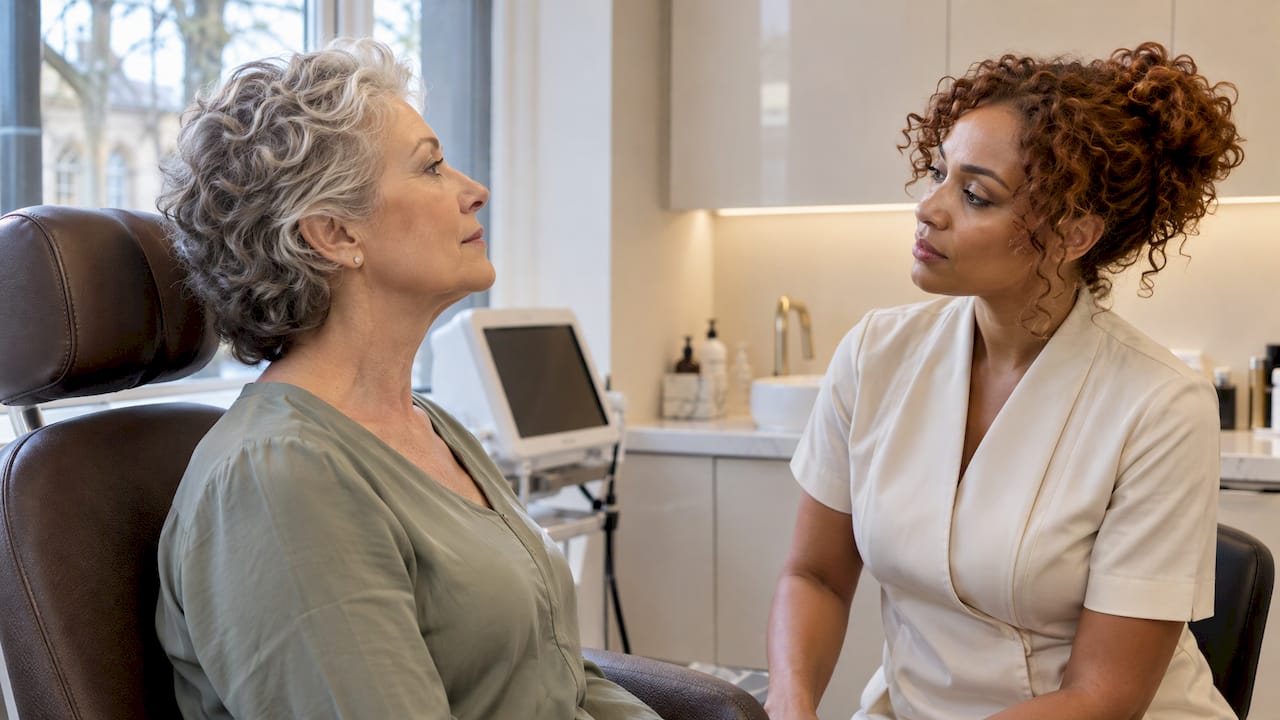

Crepey skin is thin, finely lined skin that looks like crinkled tissue paper. It responds best to a plan built around your skin rather than a single product. That plan usually starts with daily skincare, adds a treatment that improves skin quality (hydration, collagen and elasticity), and is paced so the skin is not overworked. At NexGen Clinic in Cambridge, every treatment begins with an individual assessment, because the right option for crepey skin on the neck is rarely the right one for the under-eyes or the arms.
TL;DR
- Crepey skin is a change in skin quality: thinner, drier, less elastic skin. Sun damage is the most common cause, and it can be improved but not wiped out overnight.
- Daily care matters: sun protection, moisturiser and, for suitable skin, a retinoid. Tretinoin is prescription-only and needs a prescriber's review.
- In clinic, an international 2025 consensus favours firming and collagen-stimulating approaches, and increasingly recommends combining treatments gradually.
- For the face, Profhilo, polynucleotides, skin boosters, microneedling and laser each work differently. A consultation matches the treatment to the area and your goals.
- Sudden, rapid or unexplained skin thinning should be seen by a GP or doctor first.
Table of Contents
- What crepey skin is and why it happens
- Start with skincare: the foundation for any plan
- Crepey skin treatment options in clinic
- Crepey skin on the face
- Crepey skin on the body
- Realistic expectations and pacing
- When to see a doctor first
- How we approach crepey skin at NexGen
- Book a consultation in Cambridge
- FAQ
- Sources
What crepey skin is and why it happens
Crepey skin is a descriptive term, not a diagnosis. The skin looks thin and delicate, with fine, crinkled lines that are more noticeable than deep folds. It shows most on the neck, chest, upper arms, inner thighs, backs of the hands and the skin under the eyes.
The usual causes are:
- Sun exposure. Verywell Health, in a medically reviewed article, names sun damage as the most common cause.
- Age. Cleveland Clinic says crepey skin usually begins in the 40s.
- Earlier triggers. The same source says it can appear in the 20s with long-term tanning bed use or after substantial weight gain and loss. Long-term use of oral steroids such as prednisone can also cause it.
In practical terms, the skin is making less collagen and elastin, holding less water, and the underlying support has changed. That is why a treatment that only moisturises the surface can leave a plateau, and why the better-evidenced in-clinic options work on hydration, collagen or both.
Start with skincare: the foundation for any plan
Whatever you add later, daily care sets the ceiling for your results. Verywell Health notes that moisturisers help mildly crepey skin. Where the skin is more damaged, in-clinic treatment tends to be where visible change comes from.
A sensible routine looks like this:
- Daily SPF. Sun damage is the main driver, so protection on the face, neck, chest and hands comes first.
- A gentle cleanser and lukewarm water. Very hot water can leave dry skin feeling stripped.
- A moisturiser with humectants and barrier-supporting ingredients. This improves how the skin looks and feels day to day.
- A retinoid in the evening, if your skin tolerates it.
Retinol and tretinoin
A 2023 review in the British Journal of Dermatology describes tretinoin (all-trans retinoic acid) as the clinical gold standard for topical skin rejuvenation. It has robust evidence at 0.01 to 0.1% concentrations for reducing fine and coarse wrinkling and improving texture. It is prescription-only in the UK, and the same review notes it commonly causes redness, stinging, burning and scaling.
That is why it is introduced slowly and under review. If you are weighing the two, our guide to retinol versus tretinoin explains the difference, and our note on the tretinoin purge timeline covers how to care for your skin during the first weeks. Do not use retinoids if you are pregnant or trying to conceive, and tell your clinician if you are breastfeeding.
The same British Journal of Dermatology authors suggest aiming for skin health rather than the idea of reversing age, and note that even the best programme will not change volume loss from fat redistribution and bone loss. That is a useful reason to pair good skincare with treatment chosen for what your skin and face are actually doing. Clinic-grade products are available through our clinical skincare supplies page, selected to sit alongside your treatment plan.
Crepey skin treatment options in clinic
A 2025 international consensus treatment algorithm on skin quality is the most useful recent guide. It found strong agreement that microfocused ultrasound with visualisation (MFU-V), dilute and hyperdilute calcium hydroxylapatite (a collagen-stimulating injectable) and ablative fractional lasers are preferred treatments for skin firmness. MFU-V also improves crepiness. The panel also stresses that combination treatment is emerging as the gold standard, matched to mechanism of action and the tissue layer involved.
That is the logic behind a consultation-led plan: different treatments act on different layers, so the order and combination matter.
| Approach | What it does | Best suited to | Typical course |
|---|---|---|---|
| Profhilo | Injected hyaluronic acid that spreads through the tissue to hydrate and support skin quality | Dehydrated, lax or crinkled skin on the face and neck | Sessions spaced by your clinician |
| Polynucleotides | Injectable that supports skin repair and hydration | Thin, tired, fine-lined skin, including delicate areas | Sessions spaced by your clinician |
| Skin boosters | Deep hydration injected into the skin | Dull, dehydrated skin with fine lines | Course, then maintenance |
| Microneedling | Controlled micro-injury that prompts the skin's own repair response | Texture, fine lines, early crepiness | Course of sessions |
| Laser treatments | Light energy that resurfaces and stimulates renewal | Texture and tone, more established crepiness | Depends on the device and your skin |
| Dermal fillers | Replace lost volume | Hollowing that makes skin look slack | Individually planned |
This table is a map, not a prescription. A clinician needs to see your skin type, skin tone, medical history and goals to say which row applies to you.
Crepey skin on the face
On the face, crepiness typically shows under the eyes, around the mouth, on the cheeks and across the neck. Because these areas are delicate, the aim is quality, not tightness: skin that is better hydrated, smoother and healthier-looking, with natural movement.
Profhilo
Profhilo is an injectable hyaluronic acid treatment that works on hydration and skin quality rather than adding volume. It is one of the options most often considered for skin that has started to look thin and dehydrated. Our Profhilo treatments start from £250 per session.
Polynucleotides
Polynucleotides are a regenerative skin treatment used for tired, thin or fine-lined skin. They start from £180 per session at NexGen. If you are comparing the two, Profhilo and polynucleotides are chosen for different skin concerns, and it is common to discuss them together in one assessment. Our skin boosters and Profhilo journal goes into the comparison.
Skin boosters
Our skin boosters are designed for deep hydration, which is often the first thing dull, dehydrated, crinkled skin needs.
Microneedling and laser
Microneedling uses fine needles to trigger the skin's own repair response, which is why it is described as collagen induction therapy. Laser skin treatments address tone and texture. Both are normally delivered as a course, and the intensity is set to your skin. The consensus panel advises building tolerance over time ("go slow") to avoid overchallenging the skin, particularly if it is sensitive or darker.
Fillers and threads
Where skin looks slack because of lost volume, dermal fillers (from £180) or PDO thread lifts (from £350) may be discussed alongside skin-quality treatment. These are one-off prices as published, and the right amount depends on your assessment.
What about expression lines?
Crepey skin is a skin-quality concern, while lines caused by muscle movement are a different one. If both bother you, anti-wrinkle injections can be planned alongside skin-quality treatment. Our injectables journal explains how this fits together.
Crepey skin on the body
The arms, thighs, knees and abdomen are the usual body areas. Skin there is under the same pressures: sun, hydration and loss of collagen. The same principles apply: sun protection, moisturising, suitable actives, and treatments that stimulate or support the skin. The international consensus panel names fractional lasers and collagen-stimulating approaches among its preferred options for firmness.
When there is a large amount of loose skin after major weight loss, Cleveland Clinic says cosmetic surgery may be considered. That is a decision for a surgeon. If your concern is body skin, tell us at the consultation and we will say frankly which area we can help with.
Realistic expectations and pacing
The honest picture is this:
- Improvement, not erasure. Most visible change comes from a course of treatment plus daily care.
- Several sessions. Verywell Health says energy-based treatments such as radiofrequency microneedling, ultrasound and laser usually require multiple treatments for modest results.
- Combinations over single fixes. The 2025 panel describes combining treatments by mechanism as the direction of care.
- Gradual is better. Building up the intensity over time protects the skin barrier.
If you are preparing for a wedding, holiday or event, tell us the date at the start. Skin-quality treatments build over weeks, so the earlier you plan, the more natural the result.
When to see a doctor first
Crepey skin is usually part of normal ageing and sun damage. See your GP promptly if the thinning is sudden or fast, if you have a new rash, discolouration or itching, or if other symptoms come with it. A clinician can check whether something other than ordinary ageing is involved, such as eczema or medication-related thinning. Tell your GP too if you take long-term steroids, because they can thin the skin. Any new or changing mole or lesion should also be checked before any cosmetic treatment.
Before any injectable or laser treatment, tell your practitioner if you are pregnant or breastfeeding, have a skin infection or active cold sores in the area, take blood-thinning medication, or have a history of keloid scarring. These are the questions we go through at assessment so that treatment is safe for you.
How we approach crepey skin at NexGen
We offer medically led aesthetic treatments, and we have more than 15 years of industry experience behind our consultations. We start with an assessment of your skin health, facial harmony and goals, then recommend the smallest effective plan. The aim is natural-looking results without unnecessary or excessive treatment.
For most people with crepey skin on the face, that conversation covers hydration (skin boosters or Profhilo), repair (polynucleotides or microneedling), texture (laser) and, if needed, volume. You can see everything we offer on our treatments page, and our preventative aesthetics guide explains how to start before crepiness becomes established.
Our perspective
In clinic, we find that crepey skin is rarely about one product or one machine. It is the skin telling you that hydration, collagen and support have all shifted a little, and a good plan answers all three.
That is why we begin with an assessment instead of a menu. Profhilo, polynucleotides, skin boosters, microneedling and laser each have a role, and our job is to choose the right one for your skin and to pace it so the result looks like you, only better rested.
We would rather recommend a smaller, well-judged plan than a long list of treatments. Honest recommendations and natural-looking results are what we want you to leave with.
Ms Sandra Petraskaite
Book a consultation in Cambridge
If crepey skin on your face, neck or hands is bothering you, our Cambridge clinic can assess it and set out a plan in plain terms. Profhilo starts from £250 and polynucleotides from £180 per session. The right number of sessions depends on your skin.
You can book a consultation with NexGen Clinic and bring any questions about timing, downtime or combining treatments.
FAQ
Can you repair crepey skin?
You can improve it, but a complete reversal is not a realistic promise. Sun protection, moisturiser and, where suitable, a retinoid improve skin quality, and in-clinic treatments can add hydration and stimulate collagen. Most people need a course of sessions and ongoing home care.
What is the best treatment for crepey skin on the face?
It depends on what your skin needs. A 2025 international consensus lists microfocused ultrasound, dilute calcium hydroxylapatite and ablative fractional lasers as preferred for firmness. Hydration-led treatments such as Profhilo, skin boosters and polynucleotides are discussed for thin, dehydrated skin. An assessment tells you which suits you.
Can creams and retinol help crepey skin?
Yes, especially for mild crepiness. Daily SPF and moisturiser are the base, and tretinoin has the strongest evidence among topicals but is prescription-only and can cause redness and scaling. Introduce any retinoid gradually and avoid it in pregnancy.
How long do crepey skin treatments take to work?
Skin-quality treatments build over weeks, and most plans involve several sessions. If you have a wedding or event in mind, plan well ahead and tell your clinician the date at your consultation.
When should I see a GP about thin skin?
See a GP if the thinning is sudden, rapid or comes with a rash, discolouration, itching or other symptoms, or if you take long-term steroid medication. These can have causes other than ordinary ageing.
Sources
- Cleveland Clinic: Crepey skin causes and treatment
- Verywell Health: Crepey skin causes, symptoms and treatment
- British Journal of Dermatology: Skin ageing and topical rejuvenation strategies
- How to Treat Skin Quality: a consensus-based treatment algorithm
- Crepey skin: causes and treatment, when to seek medical advice
Recommended
Ready to explore your options?
Speak with a NexGen clinician for a personalised consultation. We’ll listen, assess, and recommend the safest and most effective route — always led by evidence, always tailored to you.
Book a consultation or get in touch with our Cambridge team.