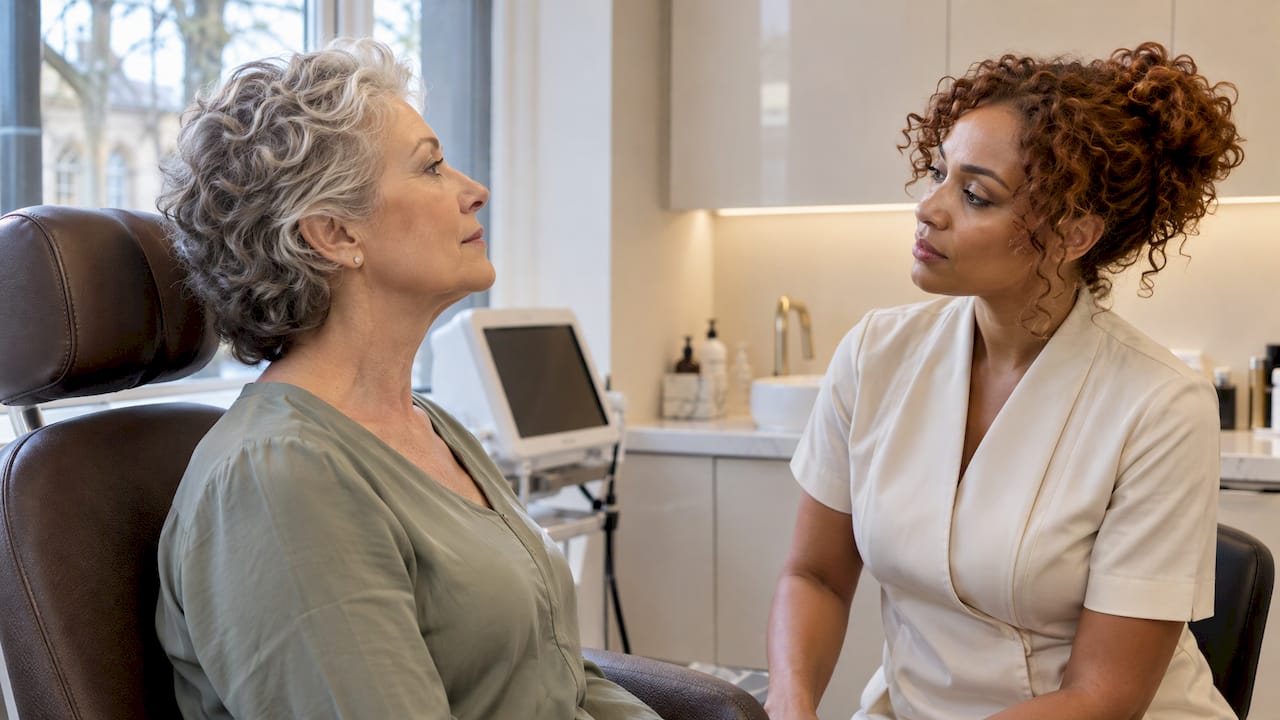

Bunny lines are the fine diagonal creases that appear on the sides of your nose when you smile, laugh or scrunch your nose. The most direct treatment is a very small, carefully placed dose of anti-wrinkle injections (botulinum toxin), given after a face-to-face assessment by a prescriber. Skincare and sun protection help the skin, and skin-directed treatments can refine lines that stay visible at rest. At NexGen Clinic in Cambridge, every treatment begins with an individual assessment, so the plan fits your face rather than a standard template.
TL;DR
- Bunny lines are mainly movement lines, so botulinum toxin, which relaxes the muscles involved, is the direct treatment.
- Placement matters: the crease sits over a muscle-free area and is pulled by neighbouring muscles, so a skilled assessment of how your face moves comes first.
- Lines that remain when your face is relaxed may soften but may not disappear completely. Polynucleotides, microneedling or laser can support skin quality.
- In the UK, botulinum toxin is a prescription-only medicine and needs a face-to-face consultation before it is prescribed.
- Sun protection, moisturiser and a retinoid protect the skin, but they do not stop the muscle movement behind the lines.
Table of Contents
- What bunny lines are and why they form
- How bunny lines are treated
- What to expect from a bunny lines appointment
- What the law requires in England
- What you can do at home
- Bunny lines treatment in Cambridge
- Our perspective
- FAQ
- Sources
What bunny lines are and why they form
Bunny lines are wrinkles on the upper side of the nose. They usually show as short diagonal or vertical creases when you smile, laugh or wrinkle your nose, and many people notice them first in photographs or on video calls.
A 2026 paper in the Journal of Cosmetic Dermatology explains that repeated use of the muscles around the nose creates dynamic wrinkles, meaning lines that appear only with movement. Over time, thinning of the dermis (the deeper layer of skin) and repeated traction can turn them into static lines that are visible at rest.
The anatomy is more interesting than most people expect. A 2025 cadaveric and ultrasound study found that the skin where bunny lines form sits over a muscle-free area, the so-called bunny triangle. It is bordered by the procerus, nasalis, orbicularis oculi and levator labii superioris alaeque nasi muscles. The crease is produced by those neighbouring muscles pulling on thin skin, not by one muscle sitting directly under the line.
This is why a general approach to the nose rarely gives a good result. Where the lines come from differs from person to person, and that shapes the treatment.
What else makes the lines deeper
Movement is the main driver, but it is not the only one. Mayo Clinic lists the usual contributors to wrinkles in general: loss of skin elasticity, fat and collagen with age, ultraviolet (UV) exposure, smoking, pollution, repeated facial expressions and family history. You cannot change your age or genetics, but UV exposure and smoking are within your control.
How bunny lines are treated
There are two questions to settle at your consultation: are your lines mostly dynamic (only when you move), or do they also show at rest? The answer decides the plan.
Botulinum toxin for movement-related lines
Botulinum toxin reduces the nerve signal to a treated muscle, so it contracts less and the skin above it folds less. For bunny lines, the injections are very small and placed on the sides of the nose.
The 2023 international consensus recommendations describe one to three injection points in the nasalis muscle, placed deep near the bone, with small doses at each point. The 2026 Journal of Cosmetic Dermatology paper goes further and recommends a border-targeted approach. Rather than injecting into the crease itself, the practitioner places tiny amounts along the borders of the muscles that pull the skin. The authors argue that injecting directly into the crease gives less predictable results, because it relies on the product spreading to the right muscle.
The same paper stresses a dynamic assessment before injecting. You are asked to smile, scrunch and wrinkle your nose so the practitioner can see which muscles dominate in your face. Because that varies between people, the plan has to as well.
Skin-directed treatments for lines at rest
If the lines are visible when your face is still, botulinum toxin may soften them but may not remove them. The JCCP information sheet on botulinum toxins says as much. Ohio State dermatologist Susan Massick makes the same distinction: toxin can help expression wrinkles, but it cannot reverse wrinkles that have already formed, while laser resurfacing can address deeper or more permanent lines.
This is where treatments that work on the skin itself come in:
| Approach | What it addresses | Best suited to |
|---|---|---|
| Anti-wrinkle injections | The muscle movement that folds the skin | Lines that appear when you smile or scrunch |
| Polynucleotides | Skin quality and hydration | Fine, thin or tired-looking skin around the nose |
| Microneedling | Collagen induction and texture | Fine static lines and uneven texture |
| Laser skin treatments | Tone and texture of the skin surface | Lines that persist at rest |
Many people combine approaches: relax the movement first, then improve the skin so the crease has less chance to settle in. The right order and timing is something your practitioner sets after assessing you. Our guide to anti-wrinkle alternatives and the comparison of laser resurfacing and light therapies explain how these sit alongside injections.
What to expect from a bunny lines appointment
Before you are treated
A good consultation is more than a quick look at the nose. You should expect:
- A face-to-face assessment. Botulinum toxin is a prescription-only medicine, and the prescriber must examine you in person first.
- A dynamic assessment. You will be asked to move your face so the practitioner can see which muscles create your lines.
- A medical history. Tell the practitioner about every medicine you take and any health conditions.
- A clear explanation of the risks. This includes that the product is used off-label for cosmetic purposes, and that the decision to go ahead is shared between you and the practitioner.
- A discussion of alternatives, including leaving the lines alone, skincare, and skin-directed treatments.
If you are new to aesthetics, our guide on what to know before your first anti-wrinkle consultation walks through the appointment in more detail.
Who should not be treated
The British Association of Aesthetic Plastic Surgeons (BAAPS) lists the situations in which botulinum toxin is avoided: neuromuscular conditions such as myasthenia gravis, pregnancy or breastfeeding, infection at the injection site, bleeding disorders, and certain medicines such as some muscle relaxants and aminoglycoside antibiotics. Tell your practitioner about any of these, and if you are unsure whether a condition or medicine applies to you, ask your GP or the prescriber before booking.
Results, timing and aftercare
Botulinum toxin does not work instantly. Results typically build over around two weeks, and the effect wears off gradually over a few months, after which the muscle movement returns. Your practitioner will tell you when a review makes sense, and a follow-up is usual after the first treatment so that any small adjustment can be made.
Common aftereffects are mild. The JCCP lists bruising, redness, localised swelling, mild discomfort and headache. The same sheet notes that treatment-related effects, such as an altered smile, resolve fully within weeks or months.
The nose is a delicate area because the muscles that lift the upper lip sit close by. If the product spreads into them, the upper lip can feel longer or the smile can look flatter for a time. This is one more reason precise, low-dose placement matters, and it fades as the medicine wears off.
Sensible aftercare usually includes:
- not rubbing or massaging the treated area
- avoiding strenuous exercise and heat, such as saunas, for the period your practitioner advises
- contacting your practitioner if anything seems wrong
- calling 999 straight away if you have any difficulty breathing or swallowing
The UK product information for Botox states that recommended doses and intervals should not be exceeded, because of the risk of overdose, exaggerated muscle weakness, spread of the toxin and the formation of neutralising antibodies. The BAAPS adds that too frequent or excessive dosing can lead to antibody formation and reduced response to future treatment. In practice, this means your plan should use the lowest effective dose at sensible intervals.
What the law requires in England
Botulinum toxin is licensed in the UK only as a muscle relaxant for medical conditions, and its cosmetic use is off-label. Under the Human Medicines Regulations 2012 it can be supplied only on prescription, according to the UK Parliament research briefing on non-surgical cosmetic procedures. Prescribers must also examine you face to face first: the General Medical Council has required this since 2016, and the Nursing and Midwifery Council applies the same requirement to nurse prescribers from April 2025.
The JCCP and CPSA guidance statement (May 2025) also says prescribers must not prescribe botulinum toxin by phone, video or online for people they have not examined in person. A follow-up face-to-face consultation is required in certain cases, for example when you move to a new treatment area, when the dose changes, after an adverse incident, or after more than six months.
On 7 August 2025 the Government confirmed a licensing scheme for non-surgical cosmetic procedures in England, as the same Parliament briefing describes. Botulinum toxin is expected to fall under local-authority licensing. Check the government's own pages for the current status, as the scheme was not yet in force when the briefing was written.
For you, the practical point is simple: if anyone offers to prescribe or treat you without seeing you in person, that is not how the guidance says it should work.
What you can do at home
Skincare will not stop the muscle movement that creates bunny lines, but it protects the skin that the lines form in. The evidence-backed basics are modest:
- Daily broad-spectrum sunscreen of SPF 30 or higher, reapplied every two hours when outdoors, per Mayo Clinic's wrinkle guidance.
- Gentle cleansing and daily moisturiser.
- A topical retinoid, which both Mayo Clinic and the Ohio State Wexner Medical Center list as an anti-ageing option. Mayo notes that over-the-counter wrinkle creams are not classed as medicines and do not have to prove they work.
- Not smoking and a healthy diet.
We also offer professional-grade skincare, and your practitioner can recommend what suits your skin at your appointment.
Bunny lines treatment in Cambridge
If you want your bunny lines softened without losing your natural expression, the first step is a consultation. At NexGen Clinic our anti-wrinkle injections start with an individual assessment, looking at your skin health, facial harmony and goals. If your skin would also benefit from regenerative care, polynucleotides start from £180 per session, and you can see the full range on our treatments page. To understand how natural results are approached, read about natural-looking Botox.
When you are ready, book a consultation and we will talk through what is right for your face, including whether treatment is needed at all.
Our perspective
Bunny lines are a good example of why we start with assessment rather than a product. The line you see on the nose is the result of several muscles pulling on thin skin, and no two faces move in exactly the same way. That is why we watch how you smile, scrunch and laugh before we suggest anything.
Our approach combines over 15 years of aesthetic experience with modern regenerative treatments. For one person, small, precise anti-wrinkle injections are the answer. For another, the priority is skin quality, and a course of polynucleotides or microneedling is a better fit. Often, an honest recommendation means doing less.
We want you to look like yourself, rested and confident, not treated. If that means a small adjustment around the nose, we will explain exactly what we plan to do, why, and what to expect afterwards.
Ms Sandra Petraskaite
FAQ
Can bunny lines be removed completely?
Not always. Botulinum toxin can reduce the movement that creates dynamic bunny lines, so they appear much softer when you smile. If a line is also visible at rest, it may soften but may not resolve fully, so skin-directed treatments are often added to improve texture.
How long does bunny lines treatment last?
The effect of botulinum toxin builds over around two weeks and typically lasts a few months before the movement gradually returns. How long it lasts for you depends on your muscles and the dose used, so your practitioner will advise on a sensible interval at your review.
Can I treat bunny lines naturally?
Sun protection, moisturiser, a retinoid and not smoking all help protect your skin from further ageing. They do not stop the muscle movement behind bunny lines, so they work best alongside a professional plan. A consultation will show which combination suits your skin.
Is bunny lines treatment safe?
When it is carried out by a qualified practitioner after a face-to-face assessment, side effects are usually mild, such as bruising, redness or a headache. Because of the nearby lip-lifting muscles, careful placement and low doses matter. Tell your practitioner about any medicines or conditions, and avoid treatment if you are pregnant or breastfeeding.
Do I need a consultation first?
Yes. In the UK, botulinum toxin is prescription-only and prescribers must see you in person before prescribing it. A consultation is also when your lines are assessed as you move your face, so the plan can be tailored to you.
Sources
- Where Should We Inject Botulinum Toxin for the Bunny Lines? (Journal of Cosmetic Dermatology, 2026)
- Anatomical etiology of bunny lines (PubMed, 2025)
- Mayo Clinic: Wrinkles, symptoms and causes
- International Consensus Recommendations on the Aesthetic Use of Botulinum Toxin (Aesthetic Surgery Journal, 2023)
- Journal of Cosmetic Dermatology: border-targeted injection paper (2026)
- JCCP Information Sheet 2: Botulinum Toxins
- Ohio State Wexner Medical Center: things that cause wrinkles
- BAAPS: Botulinum toxin injections
- BOTOX 200 Allergan Units SmPC (emc)
- UK Parliament: The regulation of non-surgical cosmetic procedures in England
- Great British and Northern Ireland Botulinum Toxin Survey (Aesthetic Surgery Journal Open Forum, 2025)
- JCCP Guidance Statement: Responsible Prescribing (May 2025)
- Mayo Clinic: Wrinkle creams guide
Recommended
- Treatment for Fine Lines
- Frown Lines (11 Lines) Treatment Guide
- Forehead Lines Treatment Without Surgery
- Natural Looking Botox - Achieve Subtle Enhancements
Ready to explore your options?
Speak with a NexGen clinician for a personalised consultation. We’ll listen, assess, and recommend the safest and most effective route — always led by evidence, always tailored to you.
Book a consultation or get in touch with our Cambridge team.