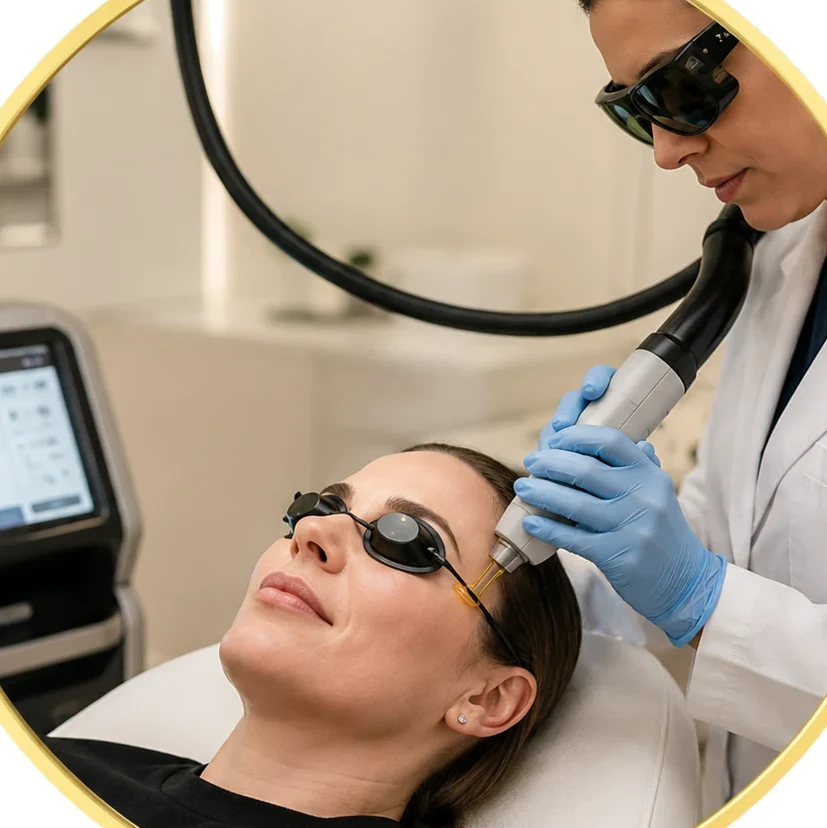

The triangle of youth is an aesthetic idea about face shape. In a youthful face, the widest part sits across the cheeks and the face tapers gently to the chin, like a triangle with its base at the cheekbones. With age, volume and collagen are lost, the cheeks flatten and the lower face becomes heavier, so the triangle appears to turn upside down. It can be addressed with treatments aimed at the cheeks, the skin and the jawline, but only after a proper assessment of what is actually changing in your face.
Below, we explain what changes, which treatments are used, what they cost at our Cambridge clinic, and the safety questions to ask before you book anything.
TL;DR
- The triangle of youth describes full cheeks, a defined jawline and a narrower chin. Ageing tends to invert it as cheek volume drops and the lower face sags.
- It is a useful way of thinking about balance, not a standard you have to meet. Your own face shape is the starting point.
- Options include cheek and jawline filler, collagen-stimulating treatments, skin boosters and polynucleotides, and PDO threads. The right mix depends on whether your concern is volume, skin quality or laxity.
- Daily SPF 30+ protects what you already have. No treatment replaces it.
- Choose a clinician who assesses first, explains risks honestly and works under clear regulation. Book a consultation if you would like a personal opinion.
Table of Contents
- What the triangle of youth actually describes
- Why the triangle inverts as we age
- Three questions that decide the treatment plan
- Treatments used to restore the triangle
- What you can do before any treatment
- Our perspective on the triangle of youth
- Safety: what to ask before you book
- Fillers and the future: a note on reversibility
- Planning for a wedding, holiday or event
- Your first consultation at NEXGEN Clinic
- FAQ
- Sources
What the triangle of youth actually describes
Look at photographs of faces in their twenties and you will often see the same pattern. Volume sits high in the mid-face, the cheeks are rounded, the skin over them is smooth, and the jawline runs cleanly from the ear to a softer chin. Drawn as a shape, the broad part is at the top and the point is at the bottom.
Three features define it:
- Cheek projection and fullness: the mid-face supports the tissues above and below it.
- A defined jawline: a continuous line without heaviness at the jowls.
- Smooth, well-hydrated skin: which reflects light evenly and makes the contours easier to see.
The term is shorthand used in aesthetic practice. It is not a medical measurement, and it describes an average pattern rather than every face. Many people look youthful and well with a face shape that is square, long or round. That is why we use it as a lens for assessment, not as a target.
Why the triangle inverts as we age
Face ageing is not one process. Several things happen together:
- Volume loss in the mid-face. The cheeks lose support and can look flatter, which lets tissue drift downwards.
- Lower collagen and elastin. Skin becomes thinner and less firm. The NHS describes loose skin as skin that has lost its elasticity and firmness, and notes it can occur as part of natural ageing, when collagen and elastin decrease.
- Descent of soft tissue. As the cheeks flatten, jowls and deeper lines around the nose and mouth become more noticeable, and the lower face looks wider.
- Surface changes. Wrinkles, uneven tone and dehydration make the face look tired even when the structure has changed little.
Genetics and the environment both play a part. A study of British and Danish women found that how old someone looks is driven significantly by wrinkling, hair greying, lip height and sun damage, with genetic and environmental factors contributing about equally. In practice, that means some of the story is out of your hands and some of it is not.
Do you need to treat the triangle at all?
Not necessarily. Many people who search this term are noticing a tired look, a heavier lower face or a flatter cheek in photographs. Sometimes the cause is volume. Sometimes it is skin quality. Sometimes it is simply sleep, sun and hydration. An honest assessment separates these, and some people leave a consultation with a skincare plan and no injectable at all.
Three questions that decide the treatment plan
We do not start with a product. We start with three questions about your face.
1. Is the main change in volume?
If the cheeks have flattened and shadows have deepened below the eyes and around the mouth, restoring support to the mid-face is often considered first. This is usually done with dermal fillers placed with attention to anatomy and proportion. Dermal fillers at our clinic start from £180.
2. Is the main change in skin quality?
If the structure is broadly intact but skin looks dull, crepey or dehydrated, the focus moves to the skin itself. Skin boosters, polynucleotides and microneedling are used for this purpose. You can read more on our Profhilo and polynucleotides pages.
3. Is the main change in firmness along the jawline?
If the jawline has softened or jowls are forming, options include jawline contouring with filler, collagen-stimulating treatments or PDO threads. Our article on anatomy-first jawline contouring explains how we think about this area.
Treatments used to restore the triangle
The table summarises the main options. It is a guide to what each treatment is for, not a prescription. Prices are the starting prices published on our site; your final cost depends on your plan.
| Treatment | Main aim | Starting price |
|---|---|---|
| Dermal fillers | Restore volume and support, for example in the cheeks or along the jaw | From £180 |
| Lip fillers | Shape and balance the lips within the lower face | From £160 |
| Profhilo | Improve skin hydration and quality | From £250 per session |
| Polynucleotides | Support skin regeneration and quality | From £180 per session |
| PDO threads | Add gentle support and lift to lax areas | From £350 |
| Anti-wrinkle injections | Soften expression lines | Price on request |
Dermal fillers for cheeks and jawline
Fillers add volume where it has been lost. In the cheeks, a small amount placed with care can support the tissue above it and soften the look of shadows and folds, without changing who you look like. Along the jaw, filler can define the line. The aim is balance. More is rarely better, and an assessment may suggest placing product in one area to improve another.
Skin boosters and polynucleotides
These work on skin quality rather than shape. Profhilo and polynucleotides are often compared, and the choice depends on your skin and your goals. Both are given as a course of sessions in our clinic, and you can see current starting prices above.
Collagen-stimulating treatments
Treatments of this type work gradually, because the skin builds its own collagen over weeks. Our guide to the 6 to 12 week timeline for Sculptra explains what to expect and when. If you have a wedding or holiday in the diary, plan well ahead.
PDO threads
Threads are dissolvable sutures placed under the skin to provide gentle support. They suit some people with mild laxity and not others, and that is a conversation for your consultation.
Anti-wrinkle injections
These soften movement lines in the upper face. They do not restore cheek volume, but expression lines can add to a tired look, so they are sometimes part of a plan. See our page on anti-wrinkle injections or our anti-wrinkle membership in Cambridge.
What you can do before any treatment
Protecting your skin is the least glamorous and most effective step. Dermatologists consistently point to sun protection as central to skin health. The British Association of Dermatologists, for example, describes actinic keratoses as areas of sun-damaged skin, a reminder of what accumulated sun exposure does. Daily SPF 30+ is a sensible baseline, not only for holidays. If you are unsure which type to choose, our guide to mineral versus chemical sunscreen helps.
A few other habits support the result:
- Use a gentle daily routine with sun protection in the morning. This skin protection checklist is a useful reference for building one.
- Consider evidence-led ingredients and give them time. Our article on peptides in skincare explains why 8 to 12 weeks is a realistic window.
- Keep hydrated and avoid smoking.
Our perspective on the triangle of youth
We like the triangle of youth as a way to explain ageing, and we are cautious about it as a goal. A face is three-dimensional and moves. Two people with the same flattening in the cheeks can need very different plans, because their bone structure, skin thickness and expressions differ.
Our approach combines more than 15 years of aesthetic experience with newer regenerative treatments, and every treatment begins with an individual assessment of skin health, facial harmony and your goals. Sometimes that means recommending a smaller treatment than you expected. Sometimes it means recommending that you wait, or that you do not treat an area at all. We would rather you feel confident and look like yourself than chase a shape.
We also encourage you to see aesthetic treatment as a medical decision. That means understanding the risks, asking who will treat you and being honest about why you want a change.
— Ms Sandra Petraskaite
Safety: what to ask before you book
The NHS is clear that all cosmetic procedures carry some risk and advises you to research what will happen before you commit. Fillers are no exception. The British Association of Dermatologists survey cited by Health Education England found 60% of responding dermatologists had treated complications of non-surgical aesthetic procedures, with dermal fillers a primary cause.
Some risks are specific to certain areas. Moorfields Private describes the Tyndall effect, a bluish tint under the skin, and other risks of under-eye filler, including the very rare but serious risk of blindness if filler enters a blood vessel. That is one reason placement and anatomy knowledge matter so much in the mid-face.
Questions worth asking any provider:
- Who will actually treat me, and what are their qualifications?
- What are the risks for my specific treatment, and what happens if something goes wrong?
- Is the product dissolvable, and is there a plan for managing complications?
- Is the clinic insured? Our guide lists aesthetics insurance questions for England.
- Will I get a consultation before treatment, and a cooling-off period to decide?
If you have a skin condition, are pregnant or breastfeeding, take blood-thinning medication or have had previous filler, tell your practitioner before any treatment. For skin changes such as a rough, scaly or changing patch, see your GP first, as those are medical questions rather than cosmetic ones.
How regulation is changing
In England, the rules are tightening. The government has said that clinics giving fillers and Botox will need to meet strict standards to obtain a licence, announced in August 2025. Under the consultation proposals, medium-risk procedures such as facial fillers and botulinum toxin would need licensed practitioners working under a named, qualified, regulated healthcare professional. Check the current position when you book, as details may change. You can read how we operate on our policies and procedures page.
Fillers and the future: a note on reversibility
Some surgeons say filler can complicate later surgery. Moorfields Private notes that surgeons may ask patients to have filler dissolved with hyaluronidase before operating. If you are thinking about a facelift or eyelid surgery in future, tell your practitioner now. Small, conservative treatments are easier to adjust than large ones.
Planning for a wedding, holiday or event
Timing matters more than most people expect.
- Start 8 to 12 weeks ahead if you are considering collagen-stimulating treatments or a course of skin boosters.
- Book filler or anti-wrinkle treatment around 4 weeks before so there is time to review the result and adjust if needed.
- Avoid anything new in the final week. Swelling or bruising is possible after injectables, so leave a margin.
- Bring photographs of how you looked when you felt your best, rather than another person's face.
Your practitioner will give you timing that fits your plan, and aftercare matters just as much. Our Botox aftercare guide covers what to do and avoid afterwards.
Your first consultation at NEXGEN Clinic
We are a medical aesthetics clinic in Cambridge. At your consultation, we look at your skin health, facial proportions and the changes that concern you, and we give a recommendation that explains what we would do first and what we would not. Treatments include dermal fillers, lip fillers, skin boosters, Profhilo, polynucleotides, PDO threads, microneedling, HydraFacial and more. You can see our full range on the treatments page, and if you are ready, book a consultation with our team.
FAQ
What is the most youthful face shape?
There is no single answer, because youthfulness depends on proportion, skin quality and expression as well as shape. The triangle of youth, with full cheeks tapering to a softer chin, is the pattern most often described in aesthetics. Plenty of people look youthful with other face shapes.
At what age does facial sagging start?
It varies from person to person and is influenced by genetics, sun exposure and lifestyle. Many people notice early changes in their thirties and forties, but there is no fixed age. A consultation can show whether what you see is volume loss, skin laxity or both.
Can the triangle of youth be restored without surgery?
Often the appearance of it can be improved with non-surgical options such as dermal fillers, collagen-stimulating treatments or threads. Results depend on your anatomy and skin, and outcomes are never assured. Surgery may be a better route for significant laxity, and we will tell you if so.
Is cheek filler safe?
All cosmetic procedures carry risks, including filler. Choosing a properly qualified practitioner, who explains complications and how they are managed, reduces avoidable problems. Tell your clinician about your medical history before treatment.
How long do results last?
This depends on the treatment, the area and your own metabolism. Filler is temporary, and skin treatments are usually given as a course with maintenance afterwards. We will discuss realistic timelines for your plan at your consultation.
Sources
- Why some women look young for their age, University of Manchester
- Weight loss (bariatric) surgery and loose skin, Chelsea and Westminster Hospital NHS Foundation Trust
- Actinic keratoses, British Association of Dermatologists
- Before you have a cosmetic procedure, NHS
- HEE cosmetic publication, part two
- The 5 key risks of under-eye filler injections, Moorfields Private
- Crackdown on unsafe cosmetic procedures, GOV.UK
- The licensing of non-surgical cosmetic procedures in England, GOV.UK
Recommended
- Neck Lines: Tech Neck Treatment Guide
- Daily Sunscreen First: UK Neck Line Treatments Compared
- Late 20s–Early 30s: When to Start Preventative Botox Based
- UK Clinician Advice: 6–12 Week Timeline for Sculptra
Explore related NexGen treatments
- Explore our full treatment menu
- Book a consultation with our clinicians
- Contact our Cambridge team
- Read more articles in the NexGen Journal
Ready to explore your options?
Speak with a NexGen clinician for a personalised consultation. We’ll listen, assess, and recommend the safest and most effective route — always led by evidence, always tailored to you.
Book a consultation or get in touch with our Cambridge team.